Leash
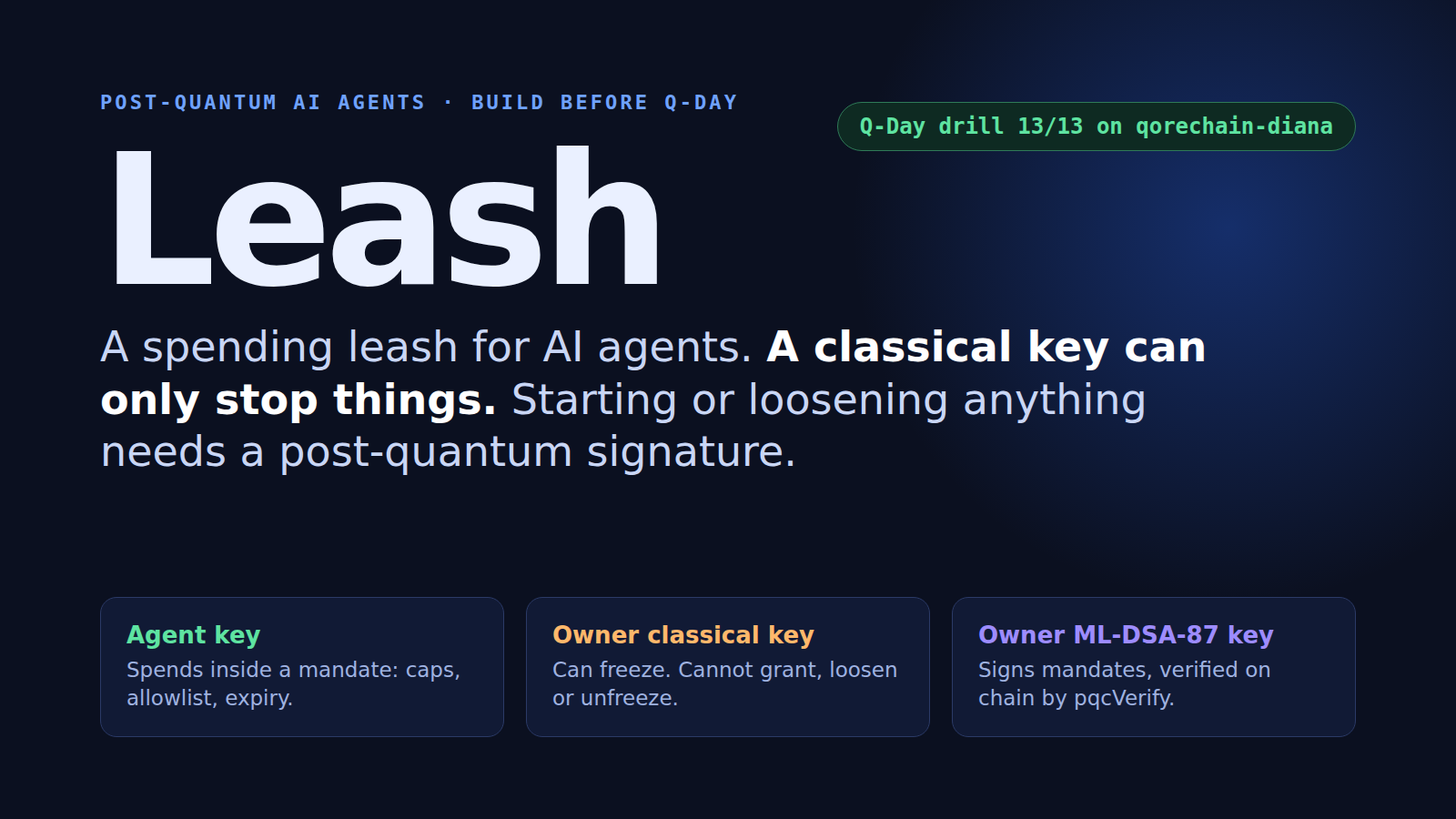
A spending leash for AI agents on QoreChain. A classical key can only stop things. Starting or loosening anything needs a post-quantum signature.
Built for QoreChain Developer Fest, "Build Before Q-Day", Post-Quantum AI Agents track. Testnet only (qorechain-diana).
Demo video (2:56, voiceover, music, captions): https://david-film-library.pages.dev/media/leash-demo.mp4
The problem
An AI agent that pays for things holds a key, and today that key is secp256k1. If it leaks, or is broken by a quantum computer, the agent can be drained. Giving the agent a spending limit does not help if the same classical key can raise the limit.
QoreChain's own rules help, but they have traps. From its docs: a missing or disabled spending rule means no limit, not zero. An ERC-20 transfer counts as zero value inside an EVM window, and allowed targets do not cap token amounts. Windows are capped at 17,280 blocks (about 6 hours). Leash closes these gaps, and tells you the ones it cannot close.
The idea in one rule
| Who | May do | May not do |
|---|---|---|
| The agent (secp256k1 key) | Spend inside a mandate: per-payment and daily caps, allowlisted recipients, until an expiry. Freeze itself. | Change anything about its own mandate |
| The owner's classical key | Freeze. It can only stop things. | Grant, loosen, extend or unfreeze |
| The owner's ML-DSA-87 key | Sign a mandate: a new agent, new limits, new recipients, unfreeze | (Everything else is on the owner) |
A mandate takes effect only when LeashGuard verifies an ML-DSA-87 signature on chain through QoreChain's pqcVerify precompile. The signed message binds the chain id, this guard, a nonce and the whole mandate, so a signature cannot be replayed on another chain or guard, used twice, or altered.
What is in the repo
src/LeashGuard.sol: the guard that holds funds and enforces the mandate.tools/policy.ts: write the leash in plain English, get a validated mandate, an on-chain plan, and a list of findings (errors, warnings, and gaps the chain does not enforce).tools/attack.ts: the Q-Day drill. It plays a leaked agent key and a leaked owner key against the guard.tools/testnet.ts: the pipeline for the real testnet (register keys, open windows, deploy, sign and apply a mandate, run the drill).tools/local.ts: the same flow on a local Anvil node with the precompiles stubbed, no wallet needed.mcp/: an MCP server and agent skill so Hermes Agent, Claude Code, Cursor and others can pay and act through the guard. See mcp/README.md.src/LeashGuardV2.solandsrc/adapters/: v2, guarded on-chain actions. The agent can swap, wrap and deposit into a vault along routes the owner signed, with the owner's rate floor enforced on what the guard actually receives. See docs/ACTIONS.md.tools/policy.tsalso reads value flows in plain English ("swap FUSD for FETH on 0x… at no worse than 0.0004 FETH per FUSD"),tools/monitor.tswatches a guard and can freeze it with a stop-only key, andtools/actions.tsbuilds the calls.
Try it
Requires Foundry, Node 22 and pnpm.
pnpm install
forge install foundry-rs/forge-std --no-git
pnpm test                 # 46 contract tests + 30 TypeScript tests (compiler, flow language, monitor rules)
pnpm demo:local           # v1: payments, the full flow and the drill on a local node
pnpm demo:local:v2        # v2: every adapter, then the drill for swaps, wraps and vaults (16 checks)
pnpm demo:monitor         # the monitor catching a burst and an unexplained outflow, freezing with a stop-only key
pnpm mcp:e2e              # an MCP client drives swaps, wraps and vaults through the server (24 checks)
pnpm compile "agent 0x70997970C51812dc3A010C7d01b50e0d17dc79C8 up to 3 QOR a day, at most 1 QOR per payment, only to 0x90F79bf6EB2c4f870365E785982E1f101E93b906 for 3 hours"
The compiler refuses what it cannot parse exactly and says so loudly when it applies a default:
LEASH REFUSED
  [error] Say who the agent may pay: 'only to 0x… and 0x…'. An empty allowlist means the agent can spend nothing.
  [error] Give at least one cap: '50 fUSD a day' or 'at most 20 fUSD per payment'.
Use it from an agent
Leash ships an MCP server and a skill. Payments: leash_status, leash_check, leash_pay, leash_freeze. Actions (LeashGuardV2): leash_routes, leash_swap, leash_wrap, leash_unwrap, leash_vault_deposit, leash_vault_redeem, leash_execute. Also leash_compile, leash_loosen_prepare, leash_monitor and leash_drill_local. The agent holds only its own key; there is no tool that loosens a mandate. Setup for Hermes Agent, Claude Code and Cursor is in mcp/README.md. Bridging is not guarded because no bridge route is live, and the doc says why.
What was proven, and where
| Check | Result |
|---|---|
| Contract tests (Foundry, stubbed precompiles) | 46 of 46 pass: 21 for LeashGuard and 25 for LeashGuardV2 and its adapters, each with a fuzz test that the agent never moves more than the daily cap |
| Compiler, flow-language and monitor tests | 30 of 30 pass |
| Mutation check, v2: break the guard on purpose | The tests fail each time: no rate floor, output to anywhere, caps skipped, approval left open, native value unchecked, no route needed |
| v2 drill, local node | 16 of 16 as expected, after a tour through all five adapter actions |
| Q-Day drill, local node | 14 of 14 as expected |
| Mutation check: break the guard on purpose | The drill fails each time: no per-payment cap (13/14), no post-quantum check (9/14), owner key allowed to spend (13/14) |
Real testnet: applyMandate with a real ML-DSA-87 signature |
Accepted by the pqcVerify precompile |
| Real testnet: Q-Day drill | 13 of 13 as expected |
| Real testnet, v2: a LeashGuardV2 mandate with swap, wrap, vault routes | Accepted by pqcVerify with a real ML-DSA-87 signature (0xd588cfa9…fd58bc), guard 0x6781ab2c…35eb |
| Real testnet, v2: every adapter as a real transaction | wrap, unwrap, vault deposit, vault redeem and swap all succeeded |
| Real testnet, v2: Q-Day drill for actions | 15 of 15 as expected (reports/testnet-v2-drill.json) |
| Real testnet, v2: an MCP client swaps and wraps through the guard | A 10 USD swap (0x20a6e7d2…e161) and a 0.5 QOR wrap succeeded; a 90 USD swap was refused by the chain (OverPerTxLimit); a router the owner did not allow has no route (transcript) |
| Real testnet: an MCP client pays through the guard | A 0.1 QOR payment succeeded; 5 QOR and an off-allowlist address were refused by the chain (transcript) |
On the testnet, guard 0xa0ebb5daf8229da498346f0c824276d126c2a34c was deployed in 0x1670f698…9669 and armed in 0x53d44e69…14ae; full hashes are in reports/testnet-drill.json. The drill ends by freezing the guard; pnpm testnet rearm later re-armed it with a second owner-signed ML-DSA-87 mandate (nonce 2) for the MCP demo.
The drill
For each attempt the expected result is stated first. A legitimate payment must succeed, so a guard that refuses everything cannot pass, and the freeze kill switch must work.
PASS  control   legitimate payment inside the mandate                        succeeded
PASS  agent key pay more than the per-payment cap                            blocked (OverPerTxLimit)
PASS  agent key pay an address that is not on the allowlist                  blocked (RecipientNotAllowed)
PASS  agent key pay in a token the mandate does not cover                    blocked (TokenNotSpendable)
PASS  agent key keep paying after the daily cap                              blocked (OverDailyLimit)
PASS  agent key loosen the mandate with a forged post-quantum signature      blocked (BadPqcSignature)
PASS  agent key loosen the mandate with a signature for a different mandate  blocked (BadPqcSignature)
PASS  agent key replay the owner's signature from a different guard          blocked (BadPqcSignature)
PASS  owner key spend directly                                               blocked (NotAgent)
PASS  owner key grant itself a bigger mandate (no post-quantum signature)    blocked (BadPqcSignature)
PASS  owner key freeze the guard (the kill switch)                           allowed
PASS  agent key keep paying after the freeze                                 blocked (IsFrozen)
PASS  owner key unfreeze with an old signature                               blocked (BadPqcSignature)
Honest limits
- Simulated blocks. On the testnet, the "blocked" rows are simulated calls that revert as expected. Only the legitimate payment, the freeze and the mandate itself are real transactions.
- Native QOR on testnet. The testnet run uses native QOR. Token limits (the gap the chain's window leaves open) are proven locally with a mock token, not on chain.
- Expiry is checked locally only. It needs a clock that can be moved.
- The guard is not audited. It is small and heavily tested, but it has not had an independent review.
- Funds outside the guard are not covered. Keep the agent's own account near zero.
- The daily cap is a fixed 24-hour bucket, not a rolling window.
- Windows must be renewed. The chain caps an EVM window at about 6 hours, so a long mandate needs a keeper holding the agent account's ML-DSA-87 key. On the testnet run, one machine held both keys for convenience; in a real deployment the agent's runtime should hold only its secp256k1 key.
- Owner post-quantum key loss is final. If the owner's ML-DSA-87 key is lost, a mandate cannot be changed. The kill switch still works.
- Testnet only. The
pqcVerifyprecompile and the authenticator module are not active on mainnet.
How the chain's own layers fit
Leash is defence in depth, not a replacement. The chain's EVM window (opened by a hybrid-signed native message) bounds the agent account's EVM transactions by time, count and target. LeashGuard then bounds what those transactions can do to the money. The plan Leash prints includes the window settings, scoped to the guard.
Credits
The pqcVerify and pqcKeyStatus usage, the idea of reading the signer's public key from the chain's key registry, and the stand-in precompile used in the Foundry tests follow the organisers' qday-vault sample (Apache-2.0). forge-std is used for tests. See AI_USAGE.md for how this was built.
Licence
Apache-2.0. See LICENSE.